

Melanotan 2 10mg
$61.99
Sale price
$61.99
Regular price
$77.99
Skip to product information
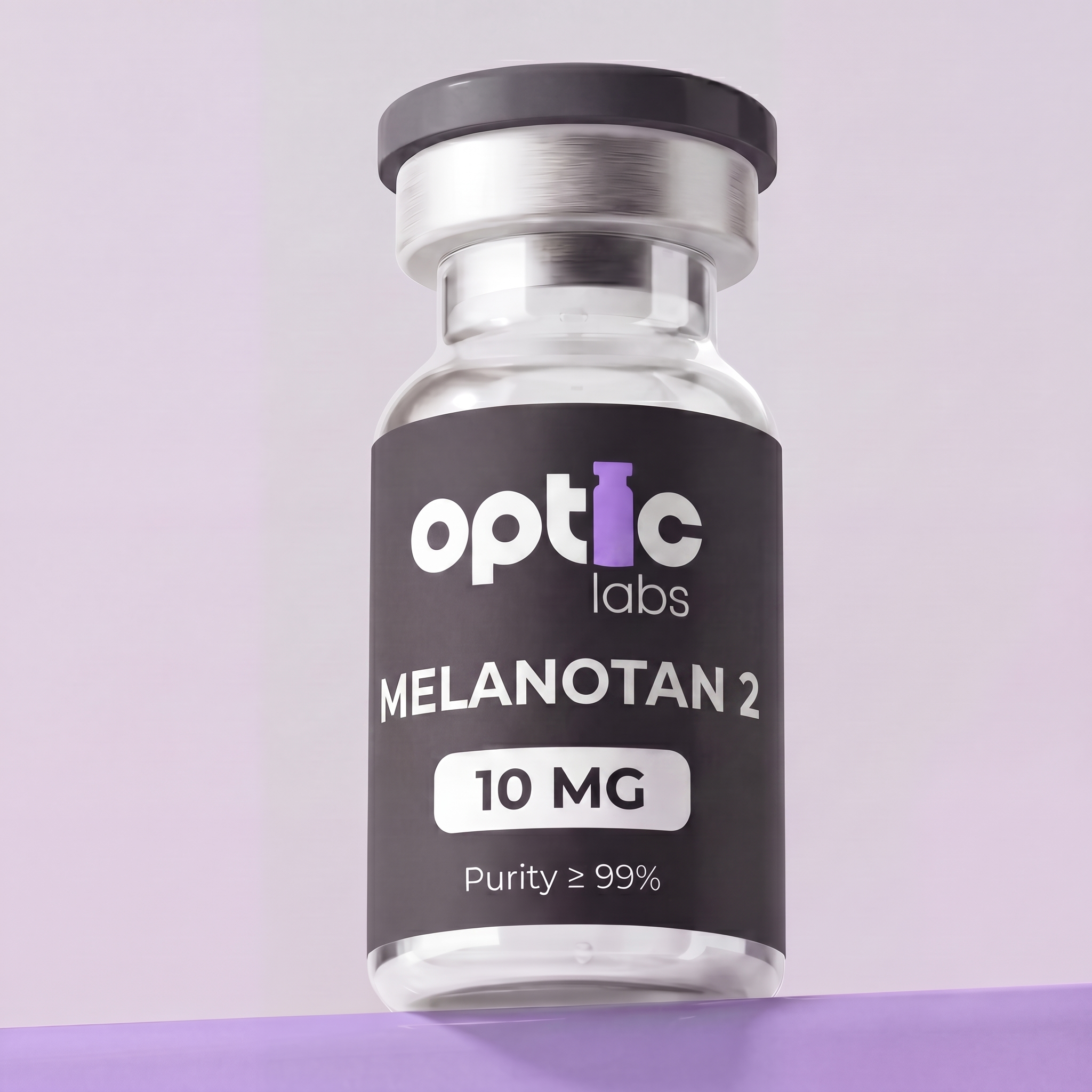
Buy high-purity Melanotan-2 (10mg) in Australia. Third-party lab tested at >99% purity. Australian-domestic shipping, AUD pricing, supplied for laboratory research use only.
About Melanotan-2
Melanotan-2 (MT-2) is a synthetic cyclic heptapeptide analogue of α-melanocyte-stimulating hormone (α-MSH), originally developed at the University of Arizona in the late 1980s as a research tool for studying the melanocortin receptor system.
The cyclic lactam bridge between Asp and Lys, together with the substitutions of Nle for Met and D-Phe for Phe, gives MT-2 substantially greater receptor-binding affinity, metabolic stability and functional duration than native α-MSH.
In published research, MT-2 is studied as a non-selective agonist of the melanocortin receptor family — primarily MC1R, MC3R and MC4R — and is one of the most extensively characterised research-grade melanocortin probes in the published literature.
Optic Labs supplies Melanotan-2 as a lyophilised powder in 10mg research vials, third-party HPLC tested to >99% purity. The product is distributed Australian-domestic from Sydney, NSW, for in vitro and laboratory research applications. Melanotan-2 is supplied strictly for laboratory research, development or analytical use and is not intended for human consumption, cosmetic use or any therapeutic application.
Product specifications
- Compound: Melanotan-2 (MT-2)
- CAS number: 121062-08-6
- Molecular formula: C50H69N15O9
- Molecular weight: ~1024.18 g/mol
- Sequence: Ac-Nle-cyclo[Asp-His-D-Phe-Arg-Trp-Lys]-NH2 (cyclic heptapeptide)
- Form: Lyophilised powder
- Purity: >99% by HPLC
- Available size: 10mg vial
- Storage: 2–8°C, protect from light. Reconstituted: 2–8°C, used within 30 days.
- Origin: Manufactured to research-grade specifications, third-party HPLC verified
- Shipping: Australia-wide domestic dispatch from Sydney, NSW
Research background
Melanotan-2 was developed by Victor Hruby and colleagues at the University of Arizona as a stabilised, broad-spectrum analogue of α-MSH for use in melanocortin receptor research. The lactam-cyclised structure both restricts the peptide to its bioactive turn conformation and protects it from peptidase degradation, giving MT-2 a much longer functional half-life than the linear native hormone.
The same research programme later generated more selective analogues, including the MC4R-preferring compound bremelanotide (PT-141). MT-2 itself remains a standard pan-melanocortin agonist in research settings.
- Melanocortin receptor pharmacology: in receptor-binding and cAMP accumulation assays, MT-2 acts as a non-selective agonist of MC1R, MC3R, MC4R and MC5R, with research interest in characterising downstream signalling profiles at each subtype.
- Melanogenesis research: in melanocyte and melanoma cell-culture studies, MT-2 has been investigated for its effects on tyrosinase activity, MITF expression and the eumelanin/pheomelanin synthesis ratio through MC1R activation.
- Hypothalamic energy balance: in rodent hypothalamic research, MT-2 has been examined as a tool for probing MC4R-mediated effects on food intake, body weight and adiposity in animal models.
- Sexual function research: in published preclinical and clinical research, melanocortin receptor activation by MT-2 and the related selective analogue bremelanotide has been investigated in the context of central pathways involved in sexual behaviour.
- Cardiovascular and autonomic effects: in animal-model research, melanocortin receptor activation has been studied for effects on blood pressure, heart rate and central autonomic outflow.
- Inflammation and immune research: in cell-culture studies, melanocortin agonists have been examined for anti-inflammatory effects mediated through MC1R and MC3R on macrophages and other immune cells.
- Photoprotection research: in cell and animal models, MC1R activation has been studied for its effects on UV-induced DNA damage repair and oxidative stress responses in melanocytes.
For a plain-language overview of peptides, see our what are peptides explainer. Researchers working with reconstitution should also reference our peptide reconstitution guide, and for laboratory injection protocols our subcutaneous injection protocol article.
Reconstitution and handling
Melanotan-2 is supplied as a lyophilised powder and must be reconstituted with bacteriostatic water before use in any laboratory protocol. A common laboratory approach for the 10mg vial is reconstitution in 2ml of bacteriostatic water to yield a 5mg/ml working stock, or in 1ml for a 10mg/ml stock.
The bacteriostatic water should be drawn into a sterile syringe and injected slowly down the inside wall of the lyophilised vial, allowing the peptide cake to dissolve passively rather than through agitation. Reconstituted MT-2 should be aliquoted, refrigerated at 2–8°C and protected from light, with research stocks typically used within 30 days.
For dilution maths across alternative volumes, see our reconstitution calculator guide. For long-term storage protocols, see our peptide storage guide.
Commonly stacked research peptides
In published research and laboratory protocols, Melanotan-2 is examined alongside other melanocortin and pigmentation-pathway research compounds:
- PT-141 (bremelanotide) — MC4R-preferring selective melanocortin agonist derived from the same research programme as MT-2.
- GHK-Cu — copper tripeptide examined alongside MT-2 in skin, fibroblast and pigmentation-related research.
- Glutathione — co-investigated in melanocyte research for its role in tyrosinase activity and pheomelanin/eumelanin balance.
- AOD-9604 — examined alongside MT-2 in metabolic and adiposity research where melanocortin pathway involvement is relevant.
- Retatrutide — metabolic research peptide co-investigated in studies of central energy balance pathways that intersect with the melanocortin system.
For broader context on combined research designs, see our peptide research stacks overview.
Frequently asked questions
Is Melanotan-2 legal in Australia?
Melanotan-2 is not registered with the Therapeutic Goods Administration (TGA) for any therapeutic or cosmetic use in Australia, and the TGA has previously issued public safety advisories regarding the importation of injectable melanocortin products. Optic Labs supplies Melanotan-2 strictly as a research chemical for in vitro and preclinical laboratory research — not for human consumption, cosmetic application or any therapeutic use.
For a full overview of how the TGA treats research peptides in Australia, see our peptide legality and TGA compliance guide.
What is Melanotan-2?
Melanotan-2 is a synthetic cyclic heptapeptide analogue of α-melanocyte-stimulating hormone (α-MSH). In published research it acts as a non-selective agonist at the melanocortin receptor family (MC1R, MC3R, MC4R and MC5R) and is used as a research tool for probing melanocortin pharmacology. For a plain-language overview of peptides, see our what are peptides explainer.
What does Melanotan-2 do in published research?
In published research, Melanotan-2 is studied for its effects on melanocortin receptor signalling, melanocyte tyrosinase activity and the eumelanin/pheomelanin synthesis ratio (via MC1R), hypothalamic regulation of food intake and energy balance (via MC4R), central pathways relevant to sexual behaviour, and macrophage anti-inflammatory signalling (via MC1R/MC3R). These observations are research findings only and do not constitute therapeutic, cosmetic or pigmentation-related claims.
How does Melanotan-2 compare with PT-141 in research?
Melanotan-2 and PT-141 (bremelanotide) were developed in the same research programme. MT-2 is a non-selective melanocortin agonist active at MC1R through MC5R, while PT-141 was engineered as a more MC4R-preferring analogue, removing some of the MC1R-mediated pigmentation activity. In research settings the two are used to probe distinct subsets of the melanocortin system.
How is Melanotan-2 supplied?
Optic Labs supplies Melanotan-2 as a lyophilised powder in 10mg glass research vials. Each vial is sealed with a tamper-evident closure. Certificates of analysis showing HPLC purity testing are available on request.
How much bacteriostatic water do I mix with a 10mg Melanotan-2 vial?
For a 10mg vial, 2ml of bacteriostatic water yields a 5mg/ml working stock; 1ml yields a 10mg/ml stock; 5ml yields a 2mg/ml stock. Choose a volume based on the concentrations required by the research protocol. For a worked example with unit conversions, see our reconstitution calculator guide.
How should reconstituted Melanotan-2 be stored?
Reconstituted Melanotan-2 should be stored at 2–8°C, protected from light, and used within approximately 30 days. For longer-term storage, aliquoting and freezing at −20°C or below is preferred to limit freeze-thaw degradation. Full handling protocols are covered in our peptide storage research guide.
Where does Optic Labs ship to?
Optic Labs ships Australia-wide from Sydney, NSW. Standard dispatch is next business day on orders received before the daily cut-off. International shipping is not currently offered.
Legal disclaimer
All products on this site are supplied for laboratory research, development or analytical use only. They are not for human consumption, clinical use, or any diagnostic, cosmetic or veterinary application. These products and statements have not been evaluated by the Therapeutic Goods Administration (TGA) or the APVMA and are not intended to diagnose, treat, cure or prevent any disease.
Optic Labs is not a compounding pharmacy or manufacturing facility as defined under the Therapeutic Goods Act 1989, and is not a registered provider of scheduled medicines or therapeutic goods.