

BAC Water 3ml / 10ml
3ml
$6.99
Sale price
$6.99
Regular price
$8.99
Skip to product information
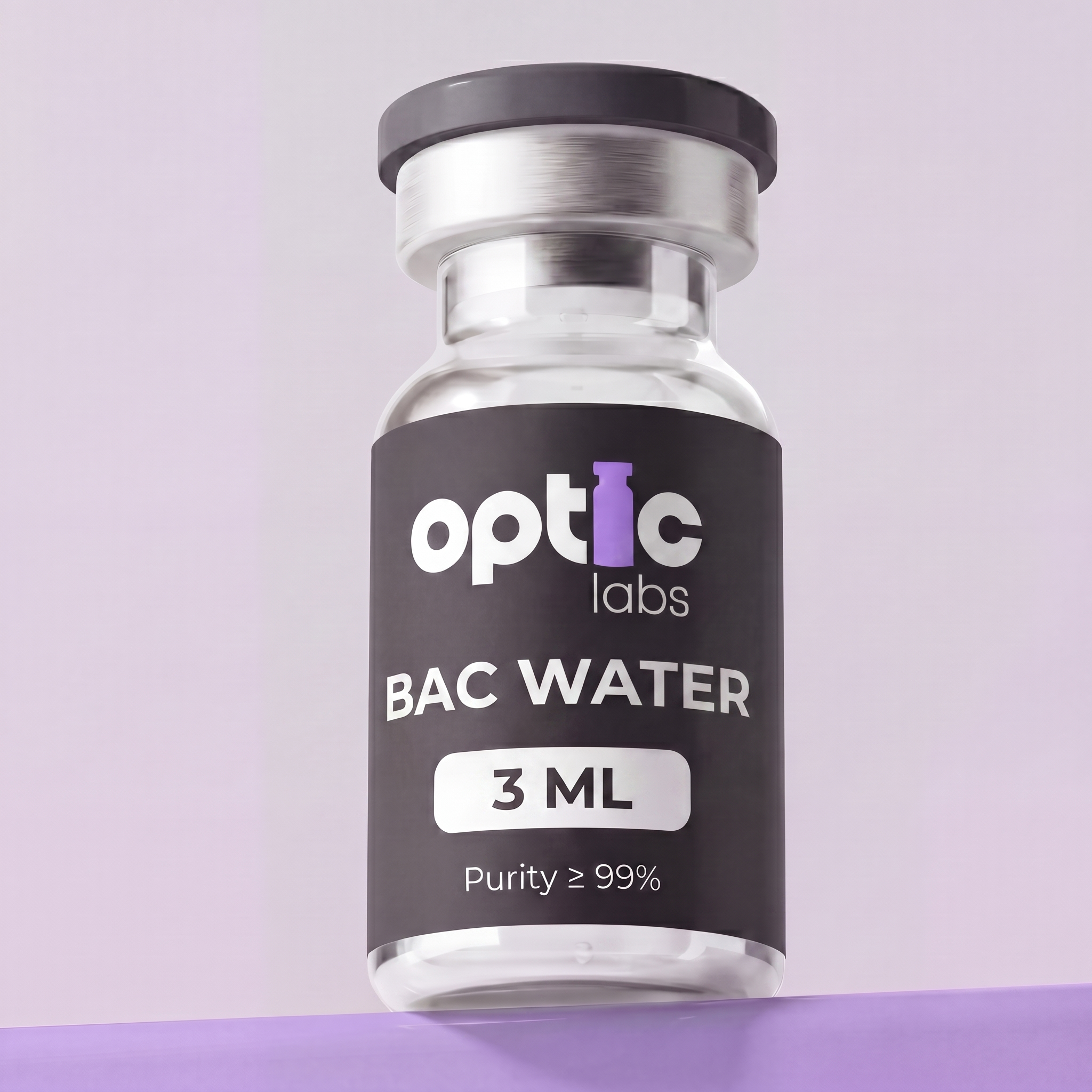
Buy bacteriostatic water in Australia (3ml and 10ml). Sterile, 0.9% benzyl alcohol preserved water for laboratory peptide reconstitution. Australian-domestic shipping, AUD pricing, supplied for laboratory research use only.
About bacteriostatic water
Bacteriostatic water (BAC water) is sterile water for injection containing 0.9% benzyl alcohol as a bacteriostatic preservative. The benzyl alcohol inhibits the growth of most common bacteria, which allows the same vial to be punctured multiple times across a research protocol without rapid microbial colonisation — a key practical advantage over plain sterile water for injection (SWFI). In peptide and protein research, bacteriostatic water is the standard reconstitution diluent for lyophilised compounds where the working stock will be used over several days or weeks.
Optic Labs supplies bacteriostatic water in 3ml and 10ml multi-dose research vials, distributed Australian-domestic from Sydney, NSW. The product is manufactured to research-grade specifications and supplied strictly for laboratory research, development or analytical use, not for human or veterinary administration.
Product specifications
- Compound: Bacteriostatic water for research use
- Composition: Water for injection USP equivalent + 0.9% w/v benzyl alcohol
- Preservative: Benzyl alcohol (CAS 100-51-6)
- pH range: Approximately 4.5–7.0
- Form: Sterile clear liquid in sealed multi-dose research vial
- Sterility: Filter-sterilised to research-grade specifications
- Available sizes: 3ml vial, 10ml vial
- Storage (sealed): Room temperature (15–25°C), protected from light
- Storage (after first puncture): 2–8°C, used within 28 days
- Origin: Manufactured to research-grade specifications
- Shipping: Australia-wide domestic dispatch from Sydney, NSW
Research background
Bacteriostatic water has been a standard pharmacopoeial diluent since the 1940s, when benzyl alcohol was introduced as a multi-use preservative for parenteral preparations. In modern peptide research, BAC water is preferred over plain sterile water because of two practical realities: lyophilised peptide vials are typically over-filled (giving 30–60 days of working stock), and laboratories need a diluent that tolerates repeated stopper puncture without microbial bloom.
- Benzyl alcohol mechanism: in microbiology research, benzyl alcohol disrupts bacterial membrane integrity at low concentrations, providing bacteriostatic (growth-inhibiting) — not bactericidal — activity against common skin and air contaminants.
- Peptide stability in BAC water: in cell-culture studies, most lyophilised peptides reconstituted in 0.9% benzyl alcohol water remain biochemically stable at 2–8°C for 28–30 days, validating the standard "use within 30 days" handling rule.
- Compatibility with sensitive compounds: in published research, benzyl alcohol is generally considered compatible with peptides such as BPC-157, TB-500, GHK-Cu, growth-hormone-releasing peptides and most short-chain analogues; researchers working with paediatric or neonatal cell models often select preservative-free SWFI instead because of historical concerns at very high benzyl alcohol exposures.
- Multi-dose puncture studies: standard handling protocols are based on 28-day post-puncture sterility data underpinning USP and BP monographs.
- Comparison to other diluents: sterile water for injection (SWFI), 0.9% saline and acetic-acid buffers are alternative diluents used in specialised research applications; selection depends on peptide solubility and downstream assay requirements.
- Reconstitution dilution maths: the volume of BAC water added to a lyophilised vial determines the mg/ml concentration of the working stock; standard dilutions are documented per peptide in the relevant research literature.
- Storage research: reconstituted peptide stability is most strongly affected by temperature, light exposure and freeze-thaw cycling rather than by the preservative itself.
For a more detailed research summary, see our bacteriostatic water research guide and our peptide reconstitution calculator guide. For long-term handling protocols, see our peptide storage guide.
Reconstitution and handling
Bacteriostatic water itself does not require reconstitution — it is supplied ready to use as a diluent. The standard laboratory workflow is to wipe the rubber stopper of both the BAC water vial and the lyophilised peptide vial with an alcohol swab, withdraw the chosen volume of BAC water with a sterile syringe, and inject it slowly down the inside wall of the lyophilised vial without disturbing the peptide cake. The peptide is then allowed to dissolve passively rather than being shaken. For specific dilution examples — including 5ml into a 5mg vial yielding a 1mg/ml stock — see our reconstitution calculator guide. After first puncture, BAC water vials should be refrigerated at 2–8°C and used within 28 days. Each Optic Labs BAC water vial is suitable for reconstituting multiple peptide vials over its in-use lifetime.
Commonly paired research peptides
Bacteriostatic water is the standard reconstitution diluent for virtually every lyophilised research peptide supplied by Optic Labs. The following are among the most commonly reconstituted with BAC water:
- BPC-157 — pentadecapeptide reconstituted in BAC water for tissue-repair and gastrointestinal research models.
- TB-500 — Thymosin β4 fragment commonly paired with BPC-157 in injury and repair research designs.
- GHK-Cu — copper tripeptide reconstituted in BAC water for skin, fibroblast and antioxidant cell research.
- CJC-1295 + Ipamorelin — GH-axis research blend reconstituted in BAC water for endocrine and metabolic models.
- Retatrutide — GLP-1/GIP/glucagon triple-agonist reconstituted in BAC water for metabolic research.
For broader context on combined research designs, see our peptide research stacks overview.
Frequently asked questions
Is bacteriostatic water legal in Australia?
Bacteriostatic water supplied for laboratory research is not classified as a therapeutic good in the same way as injectable medical products are. Optic Labs supplies BAC water strictly as a research diluent, not as a therapeutic good or medical device. For a full overview of how the Therapeutic Goods Administration treats laboratory peptide and reconstitution supplies in Australia, see our peptide legality and TGA compliance guide.
What is bacteriostatic water?
Bacteriostatic water is sterile water containing 0.9% benzyl alcohol as a preservative that inhibits microbial growth. It is the standard diluent used to reconstitute lyophilised research peptides because it tolerates multiple stopper punctures across a 28-day in-use period. For a full plain-language explainer, see our bacteriostatic water research guide.
What is the difference between bacteriostatic water and sterile water for injection?
Sterile water for injection (SWFI) is single-dose water with no preservative — once the stopper is punctured, the contents must be used immediately and any remainder discarded. Bacteriostatic water contains 0.9% benzyl alcohol, so it can be punctured repeatedly over approximately 28 days while remaining bacteriostatic. For multi-dose peptide research stocks, BAC water is the standard choice; for single-use applications or where benzyl alcohol must be avoided, SWFI is used instead.
How much bacteriostatic water do I use to reconstitute a peptide vial?
The volume depends on the peptide mass and the desired working concentration. As a general worked example, 2ml of BAC water added to a 5mg peptide vial yields a 2.5mg/ml stock; 5ml added to a 5mg vial yields 1mg/ml; 2ml added to a 10mg vial yields 5mg/ml. Each Optic Labs peptide product page lists specific dilution suggestions, and our reconstitution calculator guide walks through the unit conversions step by step.
How is bacteriostatic water supplied?
Optic Labs supplies BAC water as a sterile clear liquid in sealed multi-dose research vials at 3ml and 10ml fill volumes. Each vial has a butyl rubber stopper and a tamper-evident aluminium seal. Certificates of analysis are available on request.
How should bacteriostatic water be stored?
Sealed vials can be stored at room temperature (15–25°C), protected from light. After first puncture, vials should be refrigerated at 2–8°C and used within approximately 28 days. Vials should not be frozen, as freezing can compromise stopper integrity. Full handling protocols are covered in our peptide storage research guide.
Where does Optic Labs ship to?
Optic Labs ships Australia-wide from Sydney, NSW. Standard dispatch is next business day on orders received before the daily cut-off. International shipping is not currently offered.
Legal disclaimer
All products on this site are supplied for laboratory research, development or analytical use only. They are not for human consumption, clinical use, or any diagnostic, cosmetic or veterinary application. These products and statements have not been evaluated by the Therapeutic Goods Administration (TGA) or the APVMA and are not intended to diagnose, treat, cure or prevent any disease. Optic Labs is not a compounding pharmacy or manufacturing facility as defined under the Therapeutic Goods Act 1989, and is not a registered provider of scheduled medicines or therapeutic goods.