

DSIP 10mg
$61.99
Sale price
$61.99
Regular price
$77.99
Skip to product information
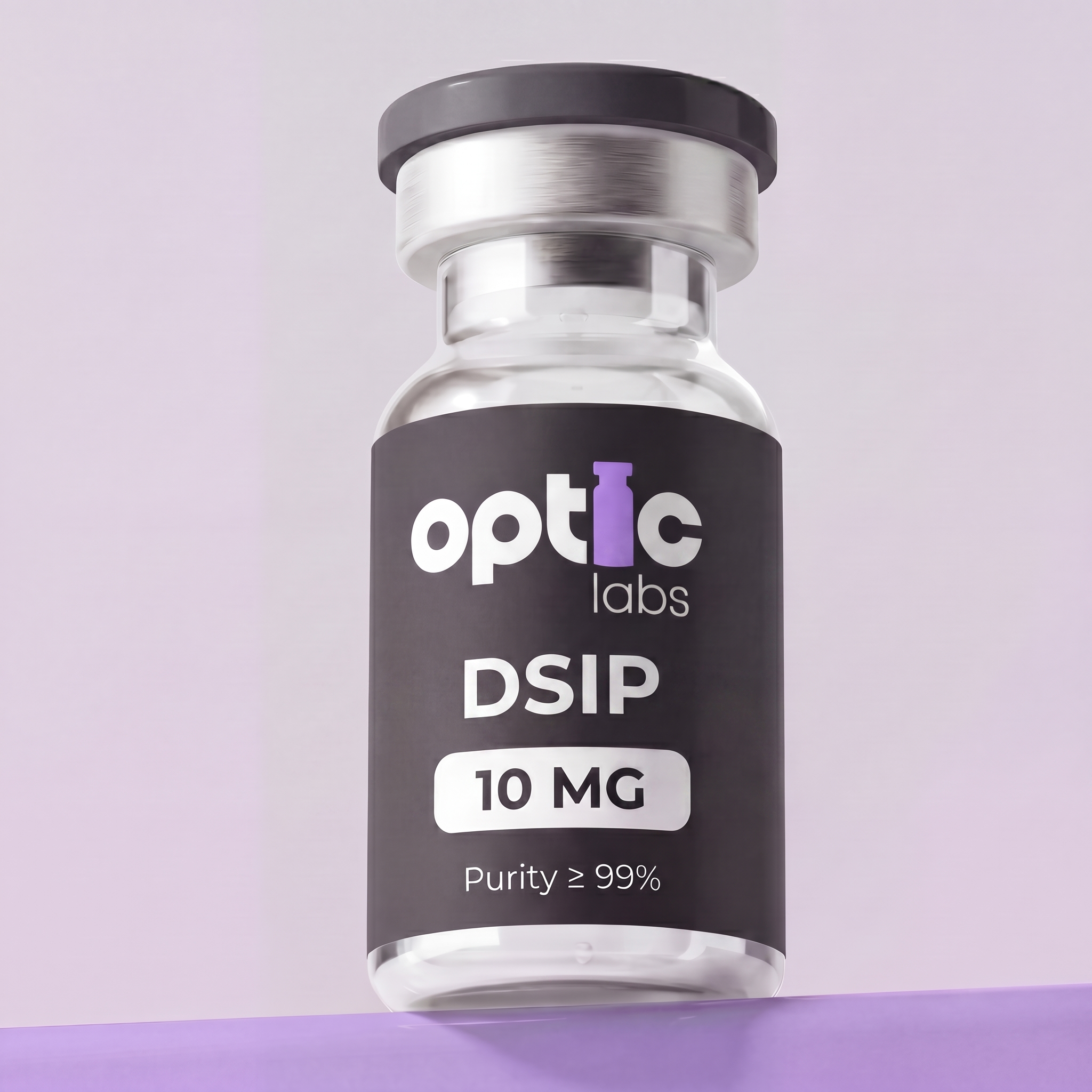
Buy high-purity DSIP in Australia (10mg). Third-party lab tested at >99% purity. Australian-domestic shipping, AUD pricing, supplied for laboratory research use only.
About DSIP
DSIP (Delta Sleep-Inducing Peptide) is a naturally occurring nonapeptide first isolated from the cerebral venous blood of sleeping rabbits in the 1970s. It takes its name from the observation that infusion of the peptide promoted delta-wave (slow-wave) EEG activity in early animal models. DSIP has since become a research tool for laboratory investigation of sleep architecture, hypothalamic–pituitary–adrenal (HPA) axis modulation, and neuroendocrine stress response.
Optic Labs supplies DSIP as a lyophilised research-grade peptide for laboratories investigating sleep-pattern modulation, circadian biology, stress-axis signalling, and analgesia models. Each vial is third-party HPLC verified at >99% purity. DSIP is supplied for laboratory research use only and is not intended for human consumption, cosmetic application, or any therapeutic purpose.
Product specifications
- Compound: Delta Sleep-Inducing Peptide (DSIP)
- CAS number: 62568-57-4
- Molecular formula: C35H48N10O15
- Molecular weight: ~848.8 g/mol
- Sequence: Trp-Ala-Gly-Gly-Asp-Ala-Ser-Gly-Glu (WAGGDASGE)
- Form: Lyophilised powder
- Purity: >99% by HPLC
- Available sizes: 10mg vial
- Storage: 2–8°C, protect from light. Reconstituted: 2–8°C, used within 30 days.
- Origin: Manufactured to research-grade specifications, third-party HPLC verified
- Shipping: Australia-wide domestic dispatch from Sydney, NSW
Research background
DSIP was first isolated by Schoenenberger and Monnier at the University of Basel in the 1970s during cross-circulation studies in rabbits, where blood from sleeping animals appeared to contain a sleep-promoting factor. The active component was sequenced as a nine-residue peptide with no homology to other neuropeptides. Decades of subsequent research have explored DSIP's behaviour across the blood–brain barrier, its interaction with neuroendocrine axes, and its possible endogenous role in sleep regulation.
- Slow-wave sleep models — early animal-model research characterised DSIP's promotion of delta-wave EEG activity in rabbit and rodent sleep studies.
- HPA-axis modulation — published preclinical work has examined DSIP's effect on ACTH, cortisol/corticosterone and stress-axis signalling.
- Circadian biology — laboratory studies have profiled DSIP's variation across the sleep–wake cycle and its interaction with melatonin signalling.
- Analgesia and pain models — animal research has explored DSIP in models of nociception and opioid-receptor cross-talk.
- Antioxidant and neuroprotective markers — in vitro work has tracked changes in lipid peroxidation, free-radical markers and cellular stress response in DSIP-exposed neural tissue.
- Thermoregulation studies — preclinical investigation has examined DSIP's effect on body-temperature regulation in rodent models.
- Tumour-bearing animal models — published research has explored DSIP in stress and disease-resistance contexts in tumour-bearing rodents.
For broader context on neuropeptide research, see our Semax nootropic research guide and our what are peptides explainer. Researchers working with reconstitution should also reference our peptide reconstitution guide.
Reconstitution and handling
DSIP is supplied as a lyophilised powder and is reconstituted prior to use with sterile bacteriostatic water. A common laboratory approach is to add 2 mL of bac water to a 10mg vial, yielding a 5 mg/mL working concentration; at this concentration, 0.1 mL drawn into an insulin syringe corresponds to 500 µg of peptide. Reconstituted DSIP should be stored at 2–8°C, protected from light, and used within 30 days. For step-by-step dilution mathematics, see our reconstitution calculator guide and our peptide storage research guide.
Commonly stacked research peptides
In published neuropeptide and circadian research, DSIP is frequently grouped with other peptides investigated for nervous-system, stress-axis and neuroprotective research:
- Semax — heptapeptide investigated for nootropic and BDNF-related research, often referenced alongside DSIP in CNS-research designs.
- Selank — tuftsin-PGP heptapeptide studied for anxiolytic and neuroimmune research, complementary to DSIP in stress-axis work.
- Glutathione — endogenous tripeptide antioxidant cross-referenced with DSIP in oxidative-stress and neuroprotective research.
- Epithalon — pineal-derived tetrapeptide referenced alongside DSIP in pineal-axis and circadian research.
- CJC-1295 + Ipamorelin — GH-axis blend referenced in sleep–GH-secretion research alongside DSIP.
For more on multi-peptide research designs, see our peptide research stacks overview.
Frequently asked questions
Is DSIP legal in Australia?
DSIP is supplied by Optic Labs strictly for laboratory research, development and analytical use. It is not approved by the Therapeutic Goods Administration for human therapeutic use and is not a registered medicine. For a detailed overview of Australian peptide research regulation, see our guide to peptide legality and TGA compliance in Australia.
What is DSIP?
DSIP (Delta Sleep-Inducing Peptide) is a naturally occurring nonapeptide first isolated from the venous blood of sleeping rabbits. It is investigated in laboratory research as a probe for sleep architecture, HPA-axis modulation, and neuroendocrine stress response. See our what are peptides explainer for broader context.
What does DSIP research focus on?
Published research has examined DSIP in animal models of slow-wave sleep, circadian rhythm, stress-axis signalling, analgesia, thermoregulation and oxidative stress. It is studied as a neuroendocrine research probe rather than a sleep treatment.
How is DSIP supplied?
Optic Labs supplies DSIP as a lyophilised powder in glass research vials, available in 10mg. Each vial is sealed and shipped with a tamper-evident seal. Certificates of analysis showing HPLC purity testing are available on request.
How much bacteriostatic water do I mix with a DSIP 10mg vial?
A common laboratory dilution is 2 mL of bacteriostatic water per 10mg vial, giving a 5 mg/mL solution. The exact volume depends on your research protocol — see our reconstitution calculator guide for dilution mathematics.
How should reconstituted DSIP be stored?
Reconstituted DSIP should be kept at 2–8°C, protected from light, and used within 30 days. Long-term storage of unreconstituted lyophilised powder should be at −20°C or colder. See our peptide storage complete research guide for handling detail.
Where does Optic Labs ship to?
Optic Labs ships Australia-wide from Sydney, NSW. Standard dispatch is next business day on orders received before the daily cut-off. International shipping is not currently offered.
Legal disclaimer
All products on this site are supplied for laboratory research, development or analytical use only. They are not for human consumption, clinical use, or any diagnostic, cosmetic or veterinary application. These products and statements have not been evaluated by the Therapeutic Goods Administration (TGA) or the APVMA and are not intended to diagnose, treat, cure or prevent any disease. Optic Labs is not a compounding pharmacy or manufacturing facility as defined under the Therapeutic Goods Act 1989, and is not a registered provider of scheduled medicines or therapeutic goods.