

CJC-1295 no DAC + Ipamorelin 10mg
$94.99
Sale price
$94.99
Regular price
$118.99
Skip to product information
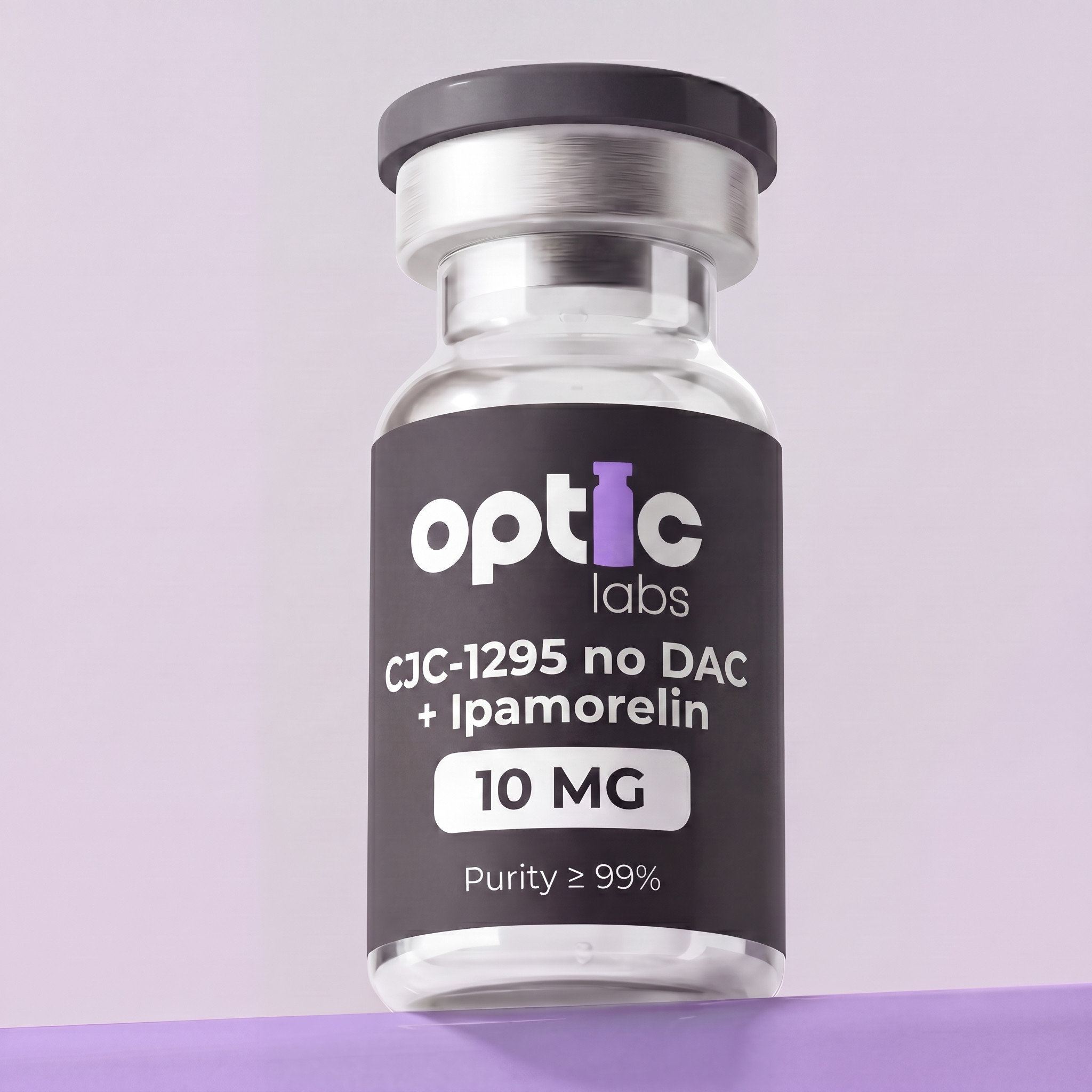
Buy high-purity CJC-1295 + Ipamorelin blend (10mg) in Australia. Third-party lab tested at >99% purity. Australian-domestic shipping, AUD pricing, supplied for laboratory research use only.
About CJC-1295 + Ipamorelin
CJC-1295 (no-DAC) and ipamorelin are two complementary growth-hormone-axis research peptides that are frequently co-studied as a blend. CJC-1295 (no-DAC), also known as Mod GRF 1-29, is a tetrasubstituted analogue of growth-hormone-releasing hormone (GHRH 1-29) that binds the GHRH receptor on somatotrophs of the anterior pituitary. Ipamorelin is a selective ghrelin receptor (GHS-R1a) agonist — a pentapeptide growth hormone secretagogue. In published endocrinology research, the two peptides act on distinct but complementary pathways: GHRH-receptor activation increases the amplitude of natural GH pulses, while a selective GH secretagogue can synergistically increase pulse frequency.
Optic Labs supplies CJC-1295 (no-DAC) and ipamorelin as a co-lyophilised research blend at 10mg total fill (5mg CJC-1295 + 5mg ipamorelin), third-party HPLC tested to >99% purity for each component. The product is distributed Australian-domestic from Sydney, NSW, for in vitro and laboratory research applications. The blend is supplied strictly for laboratory research, development or analytical use and is not intended for human consumption.
Product specifications
- Compound: CJC-1295 (no-DAC, also known as Mod GRF 1-29) co-lyophilised with ipamorelin
- CAS numbers: CJC-1295 (no-DAC): 863288-34-0; ipamorelin: 170851-70-4
- Molecular formula: CJC-1295 (no-DAC): C152H252N44O42; ipamorelin: C38H49N9O5
- Molecular weight: CJC-1295 (no-DAC): ~3367.9 g/mol; ipamorelin: ~711.85 g/mol
- Sequence (CJC-1295 no-DAC): Tyr-D-Ala-Asp-Ala-Ile-Phe-Thr-Gln-Ser-Tyr-Arg-Lys-Val-Leu-Ala-Gln-Leu-Ser-Ala-Arg-Lys-Leu-Leu-Gln-Asp-Ile-Leu-Ser-Arg
- Sequence (ipamorelin): Aib-His-D-2-Nal-D-Phe-Lys-NH2
- Form: Lyophilised powder (combined fill)
- Purity: >99% by HPLC for each component
- Available size: 10mg total (5mg CJC-1295 no-DAC + 5mg ipamorelin)
- Storage: 2–8°C, protect from light. Reconstituted: 2–8°C, used within 30 days.
- Origin: Manufactured to research-grade specifications, third-party HPLC verified
- Shipping: Australia-wide domestic dispatch from Sydney, NSW
Research background
CJC-1295 (no-DAC) was developed by ConjuChem in the early 2000s as a stabilised GHRH analogue, with four amino-acid substitutions to the native GHRH 1-29 sequence that resist proteolytic degradation. The "no-DAC" variant lacks the drug affinity complex linker present on the longer-acting CJC-1295 with DAC, giving it a shorter functional duration that more closely matches natural GH pulse kinetics. Ipamorelin was developed by Novo Nordisk as a selective GHS-R1a agonist designed to stimulate GH release without significant cortisol or prolactin responses, in contrast to earlier ghrelin-receptor agonists such as GHRP-6 and GHRP-2.
- Dual-pathway GH stimulation: in published endocrinology research, GHRH-receptor agonism (CJC-1295) and ghrelin-receptor agonism (ipamorelin) act through complementary intracellular pathways, with the combination producing larger GH pulses than either alone in animal model and isolated pituitary cell research.
- Pulsatile release pattern: in animal models, the no-DAC variant of CJC-1295 has been studied for its capacity to amplify GH pulses while preserving the natural pulsatile pattern, distinguishing it from continuous-exposure GH-axis research compounds.
- Selectivity profile (ipamorelin): in receptor-binding and rodent endocrine studies, ipamorelin showed minimal stimulation of cortisol, prolactin or aldosterone, distinguishing it from non-selective GHS such as GHRP-6.
- IGF-1 axis: in animal model research, GH-axis stimulation by CJC-1295 + ipamorelin has been associated with downstream increases in IGF-1, the principal mediator of many of GH's tissue effects.
- Body composition models: in rodent research, GH-axis stimulation has been studied in connection with adipose tissue lipolysis and lean mass parameters.
- Sleep architecture research: in published research, GH-axis activity is closely tied to slow-wave sleep, and GH-secretagogue research peptides have been studied in models of sleep architecture.
- Recovery and tissue research: GH/IGF-1 axis activity is studied in animal model research on connective tissue, bone metabolism and post-injury recovery.
For a more detailed research summary, see our CJC-1295 + ipamorelin GH stack research guide and our what are peptides explainer. Researchers working with reconstitution should also reference our peptide reconstitution guide.
Reconstitution and handling
The combined 10mg vial reconstitutes readily in bacteriostatic water. A common laboratory approach is reconstitution in 2ml to yield a 5mg/ml total working stock (corresponding to 2.5mg/ml CJC-1295 + 2.5mg/ml ipamorelin), or in 5ml for a 2mg/ml total stock (1mg/ml of each component). The bacteriostatic water should be drawn into a sterile syringe and injected slowly down the inside wall of the lyophilised vial, with the peptide cake allowed to dissolve passively rather than through agitation. Reconstituted blend should be aliquoted, refrigerated at 2–8°C and protected from light, with research stocks typically used within 30 days. For dilution maths across alternative volumes, see our reconstitution calculator guide. For long-term storage protocols, see our peptide storage guide.
Commonly stacked research peptides
In published research and laboratory protocols, CJC-1295 + ipamorelin is often co-investigated alongside other recovery, body-composition and longevity research peptides:
- BPC-157 — pentadecapeptide co-investigated with GH-axis research peptides in tissue-repair and recovery models.
- TB-500 — Thymosin β4 fragment commonly examined alongside GH-axis stimulation in injury and recovery research.
- Tesamorelin — alternative GHRH analogue studied in body composition and visceral adipose tissue research.
- Sermorelin — shorter GHRH 1-29 analogue investigated in endocrine research as an alternative GHRH-axis compound.
- NAD+ — co-investigated alongside GH-axis research compounds in longevity and mitochondrial study designs.
For broader context on combined research designs, see our peptide research stacks overview.
Frequently asked questions
Is CJC-1295 + ipamorelin legal in Australia?
CJC-1295 and ipamorelin are not registered therapeutic goods in Australia, and growth-hormone-releasing peptides are subject to specific regulatory oversight by the Therapeutic Goods Administration. Optic Labs supplies the CJC-1295 + ipamorelin blend strictly for laboratory, research and analytical use only, not as a therapeutic good. For a full overview of how the TGA treats research peptides in Australia, see our peptide legality and TGA compliance guide.
What is CJC-1295 + ipamorelin?
CJC-1295 (no-DAC) is a stabilised GHRH 1-29 analogue that activates the GHRH receptor; ipamorelin is a selective ghrelin-receptor (GHS-R1a) agonist. The two are co-supplied as a research blend because they activate complementary pathways of GH release in published endocrinology research. For a research-level summary, see our CJC-1295 + ipamorelin research guide.
What is the difference between CJC-1295 with DAC and CJC-1295 without DAC?
The "DAC" (drug affinity complex) is a maleimide linker that binds CJC-1295 to serum albumin, extending its functional half-life from hours to several days. CJC-1295 with DAC produces sustained GHRH-receptor exposure, while CJC-1295 no-DAC (Mod GRF 1-29) produces shorter pulses that more closely resemble the natural pulsatile pattern of GH release. Optic Labs supplies the no-DAC variant in this blend, which is the variant most commonly co-investigated with ipamorelin in published research.
Why are CJC-1295 and ipamorelin commonly studied together?
The two peptides act through distinct receptors — the GHRH receptor and the ghrelin receptor — that converge on the same somatotroph cell population in the anterior pituitary. In published endocrinology research, simultaneous activation of both pathways produces larger GH pulses than either compound alone, providing a useful tool for studying maximal physiological GH release.
How is the blend supplied?
Optic Labs supplies CJC-1295 (no-DAC) and ipamorelin as a co-lyophilised powder in 10mg glass research vials (5mg of each component). Each vial is sealed with a tamper-evident closure. Certificates of analysis showing HPLC purity testing for each component are available on request.
How much bacteriostatic water do I mix with a 10mg blend vial?
For the 10mg combined vial, 2ml of bacteriostatic water yields a 5mg/ml total working stock (2.5mg of each peptide per ml); 5ml yields a 2mg/ml total stock (1mg of each per ml); 1ml yields a 10mg/ml stock (5mg of each per ml). Choose a volume based on the concentrations required by the research protocol. For a worked example, see our reconstitution calculator guide.
How should the reconstituted blend be stored?
Reconstituted CJC-1295 + ipamorelin should be stored at 2–8°C, protected from light, and used within approximately 30 days. For longer-term storage, aliquoting and freezing at −20°C or below is preferred to limit freeze-thaw degradation. Full handling protocols are covered in our peptide storage research guide.
Where does Optic Labs ship to?
Optic Labs ships Australia-wide from Sydney, NSW. Standard dispatch is next business day on orders received before the daily cut-off. International shipping is not currently offered.
Legal disclaimer
All products on this site are supplied for laboratory research, development or analytical use only. They are not for human consumption, clinical use, or any diagnostic, cosmetic or veterinary application. These products and statements have not been evaluated by the Therapeutic Goods Administration (TGA) or the APVMA and are not intended to diagnose, treat, cure or prevent any disease. Optic Labs is not a compounding pharmacy or manufacturing facility as defined under the Therapeutic Goods Act 1989, and is not a registered provider of scheduled medicines or therapeutic goods.